



The customers’ perception is your reality
How a Leading Industrial Services Company Reduced Microsoft Fabric Capacity Consumption by 30%
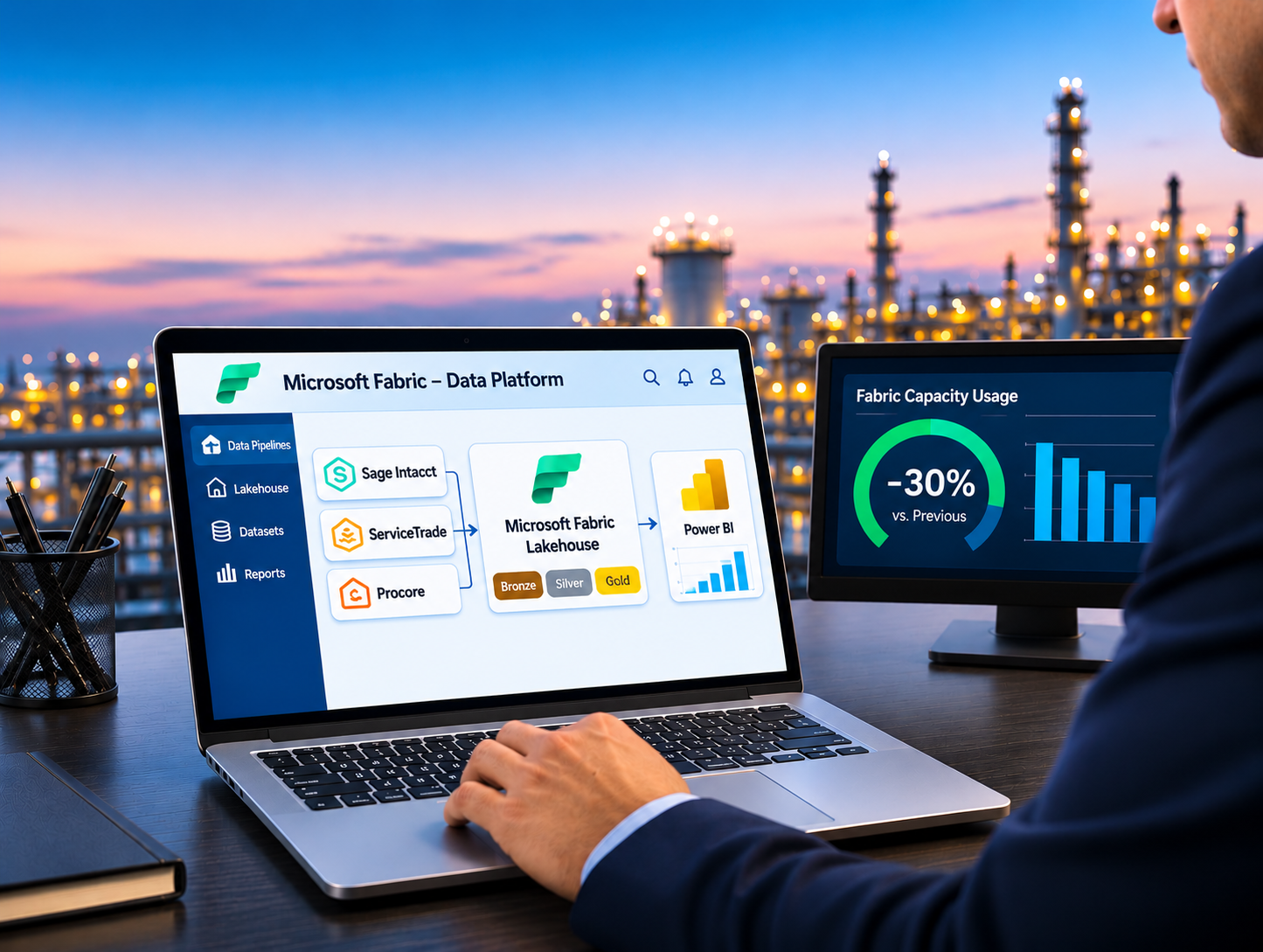
As data environments grow, inefficient data pipelines and resource-intensive processing can increase Microsoft Fabric capacity consumption and make analytics harder to maintain. Unvired helped a leading industrial services company optimize its existing Microsoft Fabric environment by replacing CData and Fivetran with native Fabric Data Pipelines, implementing a metadata-driven ingestion framework, and migrating from SQL Warehouse to Fabric Lakehouse. With a Medallion architecture, incremental data processing, and optimized Power BI connectivity, the company reduced Microsoft Fabric capacity consumption by approximately 30%, while improving data accuracy and simplifying data management.
Optimized Microsoft Fabric Capacity by 30% Through Data Platform Modernization
Company – Leading Industrial Services Company, USA
Location – Houston, Texas
Industry – Industrial Services
Solution – Microsoft Fabric Optimization, ETL Modernization, and Lakehouse Architecture
Download Case Study

Business Challenges
- Resource-intensive data extraction and processing across multiple business systems
- Full data loads increasing Microsoft Fabric compute consumption
- Complex ETL processes and dependency on third-party integration tools
- Difficult-to-maintain data pipelines and transformation logic
- Data inconsistencies across source systems
- Limited data lineage and traceability
Solution
Unvired modernized the company’s existing Microsoft Fabric architecture, focusing on data integration, processing efficiency, data quality, and reporting performance.
Key Highlights
- Replaced CData and Fivetran ETL tools with native Microsoft Fabric Data Pipelines.
- Implemented metadata-driven ETL for easier pipeline management and extensibility.
- Migrated from traditional SQL Warehouse to Microsoft Fabric Lakehouse.
- Introduced Medallion architecture with Bronze, Silver, and Gold data layers.
- Implemented incremental data ingestion to reduce unnecessary processing.
- Modernized Sage Intacct integration using REST APIs.
- Built star-schema data models for reporting.
- Reconnected existing Power BI dashboards directly to Gold-layer Lakehouse tables through updated semantic models.
- Improved data governance, access control, and traceability.
Benefits
- 30% reduction in Microsoft Fabric capacity consumption
- Simplified data integration architecture using native Fabric Data Pipelines
- Improved data accuracy and consistency across Power BI dashboards
- Reduced dependency on third-party ETL tools
- Easier maintenance and extension of data pipelines
- Improved data traceability and auditability
- More efficient data processing through incremental ingestion
- Optimized Power BI reporting architecture
About Customer
A leading industrial services company in the United States, managing service operations, projects, and financial activities across multiple business systems.
Our Blissfully Happy Customers