



AI adoption in enterprises has rapidly moved from pilots to production. Organizations are now deploying AI agents that can understand business context, access enterprise data, and trigger meaningful actions across systems such as SAP, Microsoft, and custom applications.
While AI models are advancing quickly, integrating such AI agents traditionally requires significant efforts for custom API development for each use case.
With the latest enhancement, Unvired Digital Enterprise Platform (UDEP) now natively supports Model Context Protocol (MCP), which makes it significantly easier for organizations to build and deploy AI agents.
In this blog, we explain what MCP is, why it matters, and most importantly, what it means for Unvired customers.
The Problem with Traditional AI Integrations
To understand the value of MCP, let’s look at how AI solutions have traditionally been integrated into enterprise systems.
When an AI agent needed to access data from SAP or trigger a business action, teams typically had to:
- Build custom REST APIs for each specific function
- Create separate endpoints for different data operations
- Maintain tightly coupled integrations for every new use case
This approach works—but it slows things down. Every new AI use case becomes another mini-integration project, adding time, cost, and long-term maintenance overhead.
MCP fundamentally changes this approach.
What Is MCP?
MCP is an open, standardized protocol that allows Large Language Models (LLMs) and AI agents to interact with external systems in a structured way.
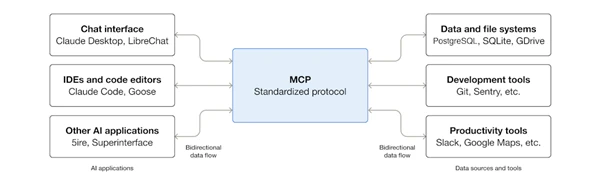
(Source: https://modelcontextprotocol.io/)
Instead of hard-coding logic like “call API A, then API B”, MCP enables AI agents to:
- Discover available capabilities
- Decide which Tool or Resource to use
- Invoke them dynamically based on context
Instead of building custom integration points for every AI use case, MCP provides a standardized approach to connect AI agents to enterprise data sources – whether that’s SAP, Microsoft systems, or any custom application you’ve built.
How UDEP Supports MCP?
With this enhancement, UDEP becomes a native MCP AI platform. Key capabilities include:
1. Full MCP Server Support
UDEP can now act as an MCP server, exposing your enterprise data and operations through the standard MCP protocol.
According to the MCP specification, servers can expose four core primitives:
- Tools: Executable functions that AI applications can invoke to perform actions, such as API calls, database updates, or business transactions.
- Resources: Data sources that provide read-only contextual information to AI applications, such as database records, file contents, or API responses.
- Resource Templates: Parameterized resources defined using URI templates, allowing AI agents to access structured data dynamically.
- Prompts: Reusable templates that help structure interactions with language models, including system prompts and few-shot examples.
This separation makes AI agents safer, more auditable, and easier to govern in enterprise environments.
2. Easy Adoption of MCP for Existing and New AI Use Cases
With MCP built into UDEP:
- You no longer need to create one-off APIs for every AI scenario
- New AI capabilities can be added incrementally
- Agents can evolve without re-architecting backend integrations
- All UDEP-supported integrations are made available to your MCP service. So you can expose MCP tools and resources from any SAP, REST, Database, or OData service.
This significantly reduces friction as AI use cases grow and mature.
A Real-World Example: Unvired AI Maintenance Genie Agent
The Unvired AI Maintenance Genie Agent is an SAP-certified AI solution that helps maintenance teams by assisting notification creation and closure, identifying failure and damage codes, analyzing sub-component root causes, and guiding technicians with relevant maintenance procedures using RAG.
Originally built in Python, the Genie Agent relies on custom REST APIs to interact with SAP—a proven approach, but one that requires orchestration logic in the application.
With MCP support in UDEP, we’re modernizing the Genie Agent so the same capabilities can now be exposed more flexibly:
- SAP data (equipment history, notifications, work orders) can be exposed as MCP Resources
- SAP actions (create or update notifications, propose codes, close notifications) can be exposed as MCP Tools
- Parameterized access to equipment and notification data can be modelled using Resource Templates
- Standardized Prompts can guide how the AI reasons over maintenance scenarios
Instead of embedding orchestration logic within the application, the Genie can dynamically decide which tool or resource to invoke based on the context.
Genie’s availability via MCP built on UDEP makes it easier for not just the chat interface within the application to access it, but also enterprise agents like Microsoft Copilot and custom AI systems, making the solution easier to reuse, integrate, and scale across the enterprise.
Faster AI Delivery with AI-Assisted Development
An interesting side note: this entire MCP and agent framework was built in 2 weeks using AI-assisted development with Gemini Pro in the Antigravity IDE. Without AI assistance, the same work would have taken 4-6 weeks. That’s completing the project in 40-50% less effort than the traditional way.
That same acceleration is now available to Unvired customers—helping them move from idea to working AI agent much faster than before.
What This Means for Unvired Customers
- MCP-Enabled Applications: MCP enables any application deployed on the UDEP platform to participate in AI-driven workflows.
- Single Platform: Manage your mobile apps, backend integrations, and AI agents all from one platform.
- Faster Time-to-Value: AI agents that take months to integrate can now be deployed in weeks—or less.
- Lower Integration Cost: No need for dozens of custom APIs. MCP provides a clean, standardized interface.
- Future-Proof AI Architecture: As LLMs evolve, MCP ensures compatibility without rewriting integrations.
- Enterprise-Grade Governance: Clear separation of read vs write actions, predictable tooling, and controlled access.
Looking Ahead:
We’re already working on additional enhancements, including reference implementations and templates for common enterprise scenarios. Our goal is to make deploying enterprise AI agents as straightforward as building any other integration in UDEP.
This is just the beginning- we’re excited to see what our customers build with it.
Want to explore how MCP support can accelerate your AI initiatives? Let’s talk